Kepler CEO shares rules for forward deployed engineers
Kepler CEO Vinoo Ganesh has outlined a framework for the highly sought-after forward deployed engineer role, warning AI companies not to mistake the position for traditional consulting.
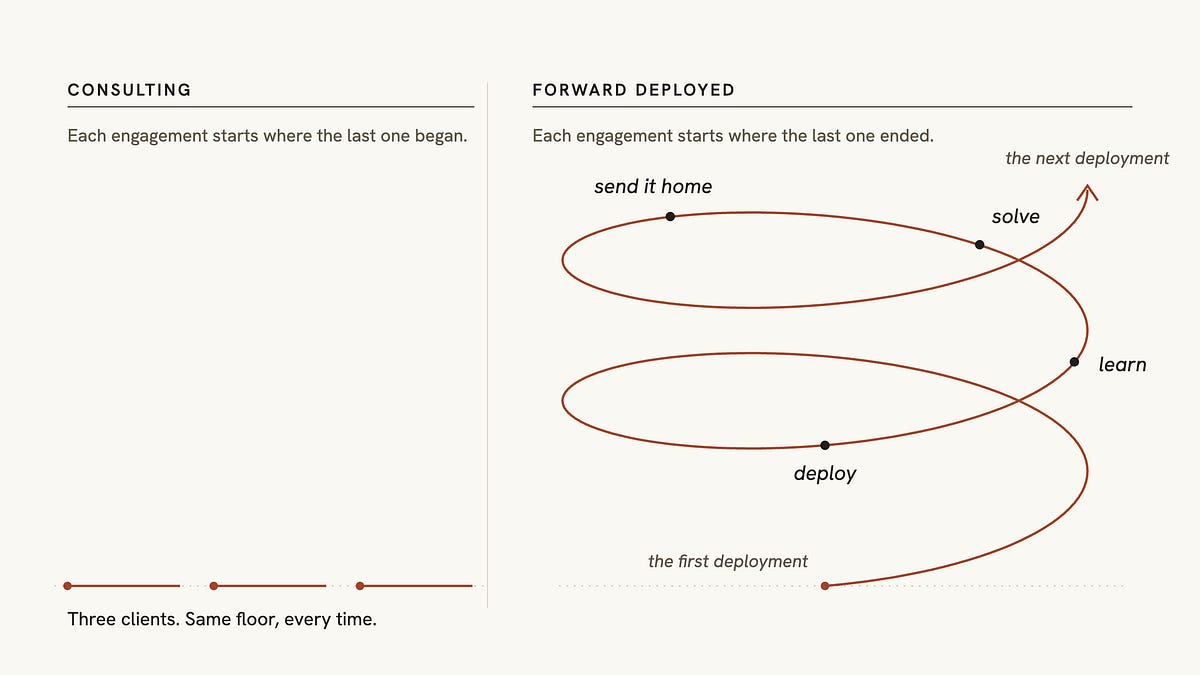
As artificial intelligence startups, labs, and private equity firms rush to hire forward deployed engineers (FDEs) to embed within customer operations, Kepler CEO Vinoo Ganesh warned that many organizations are mismanaging the role. Drawing on his experience leading Palantir's Project Frontline—a rotation program that trained approximately 250 engineers who now lead FDE teams at OpenAI, Anthropic, xAI, and Anduril—Ganesh argued that FDEs must function as extensions of the product team rather than sales or consulting units.
According to Ganesh, the true purpose of an FDE is to solve 'last-mile' customer problems to gather insights that improve the core platform. He illustrated this with his experience at Palantir building the Phoenix transaction store. When deployed at a bank, blank timestamps defaulted to 1970, causing Cassandra to request 2.3 million keyspaces. Because Cassandra required five megabytes per file handle, the server crashed and required 14 terabytes of RAM to restart. This failure highlighted the necessity of having engineers observe production data firsthand. In another instance, an FDE observed a client manually double-clicking CSV files to verify data quality, which blocked a migration to Parquet. By building a Parquet viewer overnight, the team unlocked the migration and slashed pipeline execution time from 17 hours to just two.
Ganesh cautioned against solving problems locally without feeding solutions back into the main product. He recalled once writing a temporary data retention script called 'vinoo.groovy' that ended up running across a customer base of nearly 100,000 people for years because it was never properly productized. To avoid this trap, Kepler structures its FDEs to report directly to product rather than sales. This alignment ensures that every customer deployment makes the next one cheaper and faster, turning custom services into reusable product assets.
For AI practitioners, this distinction defines the difference between selling billable hours and building a compounding technical moat. Ganesh noted that in an era where AI models are rapidly commoditizing, the ultimate competitive advantage lies in an accumulated, verified understanding of how customer workflows actually operate. By embedding FDEs to map these workflows and systematically folding those lessons back into a centralized platform, companies can drastically lower the cost of future deployments and outpace competitors.
This is our own summary of reporting by Latent Space